
Start Here:
What Is Peripheral Neuropathy?
A Simple Guide
If you are newly diagnosed, worried about symptoms, or simply trying to understand peripheral neuropathy, you are not alone.
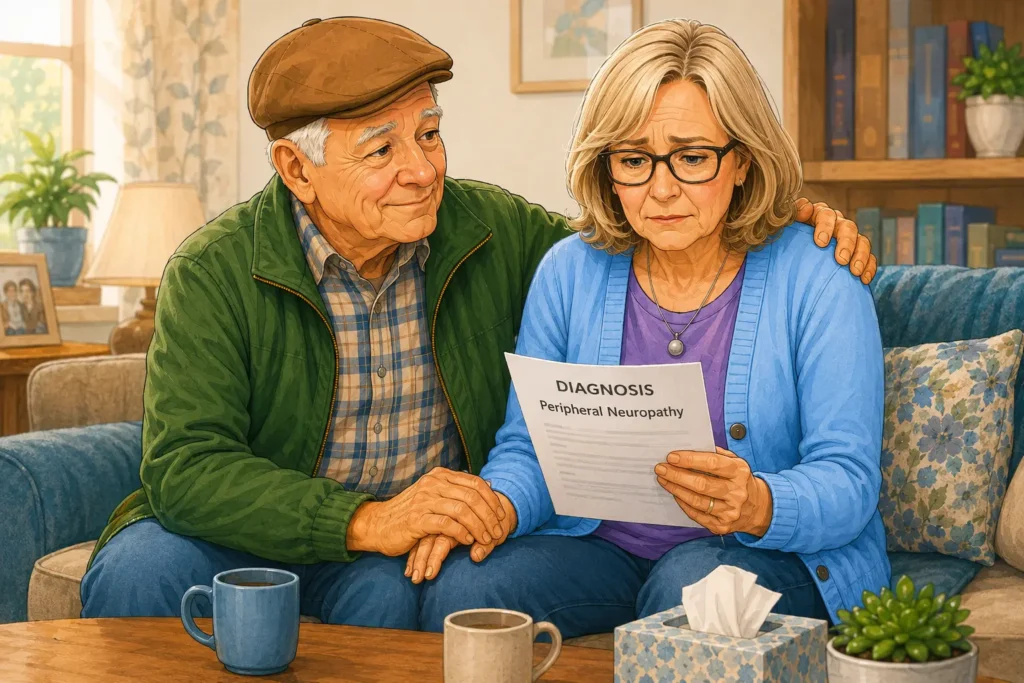
⚠️ Important: A Quick Friendly Note
I am not a doctor or medical professional — just someone living with peripheral neuropathy and sharing information, experiences and research that may help others feel a little less alone. ABOUT
Everything on My Peripheral Neuropathy Journey is intended for general information and support only and should never replace professional medical advice, diagnosis or treatment.
If you are worried about symptoms, notice sudden changes, or are unsure about anything relating to your health, please speak to your doctor or healthcare professional.
Always follow the advice of your own medical team.
If you have recently been told you have peripheral neuropathy, there is a fair chance life suddenly feels a little uncertain.
You may have left an appointment with questions spinning around your head.
What exactly is it?
Will it get worse?
Can anything help?
Why do my symptoms feel so strange?
If that sounds familiar, you are certainly not alone.
Many of us discover that the words “peripheral neuropathy” arrive long before clear explanations do.
The good news?
You do not need to understand everything overnight.
This page is simply a calm place to start.
Together, we will look at what peripheral neuropathy actually means, what symptoms people often experience, how doctors diagnose it, what treatments may help — and importantly, why there is still reason for hope.
No scary jargon overload.
No pretending every experience is the same.
Just a practical, honest guide written in plain English.
Quick Summary
- Peripheral neuropathy means damage or disruption to nerves outside the brain and spinal cord.
- Symptoms vary hugely between people.
- Tingling, numbness, burning, pain and balance issues are common.
- Some causes can be treated. Others remain unclear.
- Many people learn practical ways to manage symptoms and continue living full lives.
So… What Is Peripheral Neuropathy?
Let us start with the basics. Put simply:
Peripheral neuropathy is damage or disruption to nerves outside the brain and spinal cord.
Those nerves are called peripheral nerves.
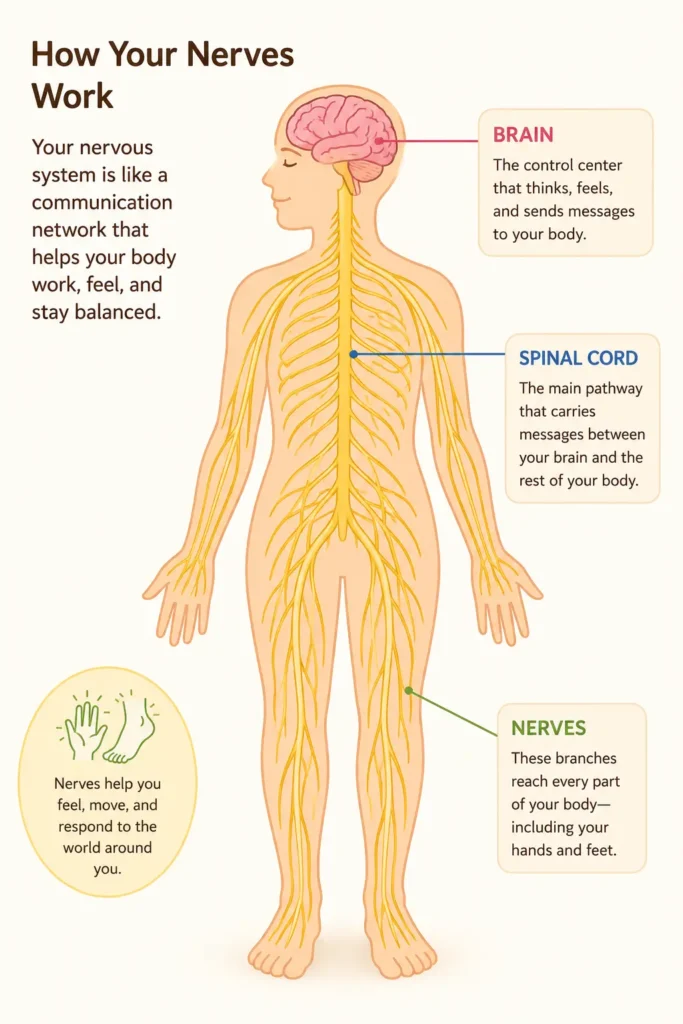
You can think of them as the body’s communication network.
They carry messages:
- From your brain to muscles, helping with movement
- From your body back to your brain, carrying messages about touch, pain and temperature
- To automatic body systems like digestion, sweating and blood pressure
When nerves are damaged, messages can become confused.
Sometimes signals become weaker.
Sometimes stronger.
Sometimes they seem to misfire completely.
And that is often why symptoms can feel so odd — and sometimes difficult to explain to other people.
One person may experience burning feet.
Another feels numbness.
Someone else struggles with balance.
And many people experience a mixture.
There is no single neuropathy story.
One of the frustrating things about peripheral neuropathy is that no two people seem to experience it in exactly the same way.
Why Does Neuropathy Often Start in the Feet?
This puzzled me at first too.
Why feet?
Why not somewhere else?
The answer is surprisingly simple.
The nerves reaching your feet are among the longest nerves in the body.
Longer nerves are often more vulnerable to damage.
That is one reason symptoms commonly begin with:
- Tingling toes
- Burning feet
- Numbness
- Strange sensations
- Feeling like you are walking on cotton wool
Over time, symptoms may slowly move upwards.
Doctors sometimes call this:
“Stocking pattern neuropathy”
because symptoms often spread in a way similar to wearing socks or stockings.
Hands may become involved later for some people.
But not always.
And this is important:
Neuropathy does not read textbooks.
Your experience may be completely different from someone else’s.
Want the deeper explanation of what nerves actually do?
Read:
What Is Peripheral Neuropathy? Understanding the Basics
What Symptoms Can Peripheral Neuropathy Cause?
This is usually the question most people ask next.
And understandably so.
Symptoms can feel strange, worrying and sometimes downright difficult to describe.
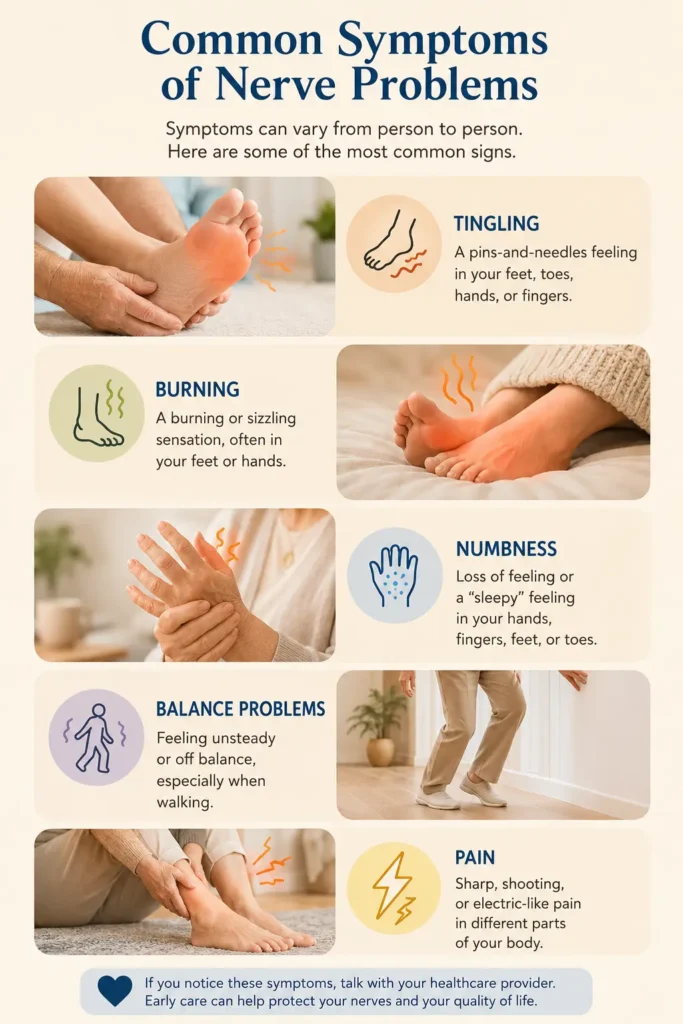
Sensory symptoms
- Tingling or pins and needles
- Numbness
- Burning sensations
- Electric shock feelings
- Sharp pains
- Heightened sensitivity
Movement symptoms
- Weakness
- Reduced grip
- Trouble climbing stairs
- Foot drop
Balance symptoms
- Feeling unsteady
- Difficulty walking in darkness
- Increased risk of trips or falls
Automatic body symptoms
Some people also notice symptoms involving automatic body functions:
- Dizziness when standing
- Digestive issues
- Changes in sweating
- Bladder changes
And here is something worth saying clearly:
Just because someone else has neuropathy does not mean your symptoms will follow the same path.
Comparing yourself to others can sometimes create unnecessary worry.
Useful information? Yes.
Scary internet rabbit holes? Probably best avoided.
Want a fuller explanation?
Read:
Peripheral Neuropathy Symptoms Explained: Why Everyone Is Different
What Causes Peripheral Neuropathy?
There are many possible causes.
Some are very common.
Others are surprisingly rare.
Some of the more common causes include:
- Diabetes
- Vitamin deficiencies
- Certain medications
- Alcohol misuse
- Autoimmune conditions
- Chemotherapy
- Infections
- Injuries
- Genetics
And sometimes…
No clear cause is found at all.
That can feel frustrating.
Many people quietly wonder:
“How can doctors not know?”
Unfortunately, neuropathy is not always straightforward.
The body can be wonderfully complicated — and occasionally stubbornly mysterious.
Read:
What Causes Peripheral Neuropathy? 20 Common Causes Explained
What Does “Idiopathic” Mean?
If you have been told you have:
Idiopathic neuropathy
please know this:
It simply means:
No definite cause has yet been found.
It does not mean:
- Your symptoms are imaginary
- Nobody believes you
- There is no hope
- Nothing can be done
In fact, many people live with idiopathic neuropathy.
Research continues all the time.
And sometimes answers emerge later.
Want to understand this more clearly?
Read:
Idiopathic Neuropathy: When Doctors Cannot Find a Cause
How Is Peripheral Neuropathy Diagnosed?
You may already have discovered this part can feel slower than expected.
Many people go through:
Appointments.
Blood tests.
Waiting.
More appointments.
More questions.
Sometimes a fair amount of uncertainty too.
Doctors may look at:
- Symptoms
- Medical history
- Family history
- Medication use
- Existing conditions
- Lifestyle factors
They will often check things like:
- Reflexes
- Balance
- Muscle strength
- Sensation in hands and feet
Blood tests are commonly used to rule out causes that might be treatable.
Tests Doctors May Use
Not everyone has every test.
That is perfectly normal.
Some common tests include:
Blood tests
Checking for issues like:
- Diabetes
- Vitamin deficiencies
- Thyroid problems
- Inflammation
Nerve Conduction Studies (NCS)
These check how well nerves carry signals.
Electromyography (EMG)
Measures electrical activity in muscles.
Now for a small piece of reassurance:
Many people worry about these tests beforehand.
The reality?
Most people find they are more uncomfortable than frightening — and often easier than expected.

Want the full picture?
Read:
How Peripheral Neuropathy Is Diagnosed
And:
Read:
Neuropathy Tests Explained: EMG, Nerve Conduction Studies & More
Can Peripheral Neuropathy Be Treated?
This is understandably one of the biggest questions.
The honest answer is:
It depends on the cause — but help is often available.
Sometimes treatment focuses on the underlying cause.
For example:
- Better blood sugar control
- Vitamin replacement
- Medication changes
Sometimes treatment focuses on symptoms:
- Pain relief
- Better sleep
- Balance improvement
- Physiotherapy
- Exercise
- Practical lifestyle changes
And this matters:
Not everyone steadily gets worse.
Some people stabilise.
Some improve.
Others adapt remarkably well over time.
Neuropathy is not one single journey.
Want a more detailed guide?
Read:
Peripheral Neuropathy Treatments: Medicines, Therapies & What Really Helps
Living With Peripheral Neuropathy Day to Day
This is often the part nobody prepares us for.
The practical side.
Many people slowly learn little adjustments that make life easier.
Better shoes.
Different routines.
Pacing activities.
Gentle exercise.
Being a little kinder to ourselves on difficult days.
The strange thing?
Small changes often add up more than expected.
And many people gradually regain confidence.
Even if life looks slightly different than before.

Want practical tips?
Read:
Living With Peripheral Neuropathy Day to Day
The Emotional Side Nobody Warns You About
This deserves mentioning.
Because it matters.
Peripheral neuropathy is often invisible.
From the outside, people may think:
“You look fine.”
Meanwhile you may be juggling pain, poor sleep, uncertainty, frustration — or fear.
If you sometimes feel worried, low or overwhelmed:
You are far from alone.
Many of us quietly wonder:
“Will life ever feel normal again?”
The honest answer?
Things may change.
But many people slowly find a new rhythm.
A different normal.
And life often becomes less frightening once the uncertainty settles.
Want help with this side of things?
Read:
The Emotional Side of Neuropathy: Anxiety, Fear & Invisible Symptoms
Is There Hope for Better Treatments?
I believe it is important to be realistic here.
No miracle cure exists today.
But there is genuine reason for cautious optimism.
Research is improving all the time.
Scientists are exploring:
- Better diagnosis tools
- Earlier detection
- Nerve regeneration
- Better pain treatments
- Personalised medicine
Progress can sometimes feel frustratingly slow.
But it is happening.
Want to see what may be coming?
Read:
The Future of Peripheral Neuropathy Treatment: What Might Be Coming?
When Should You Seek Medical Advice?
Please speak to a healthcare professional if:
- Symptoms suddenly worsen
- Weakness develops quickly
- Walking becomes unsafe
- Symptoms spread rapidly
- Falls increase
- Something simply does not feel right
Trust your instincts.
If you are worried:
Get checked.
Final Thoughts
If things feel confusing right now, that is understandable.
Neuropathy can feel like a lot to take in at first.
But thankfully:
You do not need to understand everything overnight.
Take things one step at a time.
Read what feels helpful.
Leave the rest for another day.
Nobody becomes an expert in peripheral neuropathy overnight — and thankfully, you do not need to.
One small step at a time is enough.
And wherever you happen to be on this journey:
💚 A Message From John and Mary
“You are not walking it alone”
Peripheral Neuropathy Glossary
PN Glossary – Medical Terms Explained in Plain English
Medical Disclaimer
This article is for educational and informational purposes only and should not be considered medical advice. Always consult your doctor, neurologist, or healthcare professional regarding symptoms, diagnosis, treatment options, or changes to your healthcare plan. Medical knowledge changes over time, and treatment decisions should always be based on your individual circumstances and professional medical guidance.
If you experience new symptoms, worsening symptoms, falls, sudden weakness, or concerns about your health, seek professional medical advice promptly.