
Peripheral Neuropathy Glossary – Medical Terms Explained in Plain English
Confused by all the medical words? You are not alone.
If you have recently been diagnosed with peripheral neuropathy, the language can feel confusing — and sometimes downright frightening.
You may have opened a hospital letter and found yourself staring at words that look impossible to pronounce, let alone understand.
Axonal. Idiopathic. Polyneuropathy. Demyelinating.
Nobody hands you a medical dictionary when you are diagnosed.
And if you have ended up searching online, there is a good chance you found explanations written for doctors rather than ordinary people trying to make sense of what is happening to them.
That is exactly why this glossary exists.
This page explains the most common peripheral neuropathy words, terms and phrases in plain English, without unnecessary medical jargon.
You do not need to learn everything at once.
Just start with the words that appear in your diagnosis, symptoms or medical letters and come back whenever something unfamiliar pops up.
You will slowly begin to understand the language — and things usually feel a little less frightening once they start making sense.
Please note: This glossary is for general understanding only and should not replace advice from your doctor or healthcare professional.

New Here? Start With These 10 Words
If you are newly diagnosed, forget trying to understand everything all at once.
These are probably the 10 most useful neuropathy words to understand first.
- Neuropathy
Damage or disease affecting nerves. - Peripheral Neuropathy
Damage affecting nerves outside the brain and spinal cord, often in the feet, legs, hands or arms. - Neuropathic Pain
Pain caused by damaged or irritated nerves, rather than from a normal injury. - Idiopathic
The cause is unknown. - Axonal
Damage to the nerve fibres themselves — the nerve “wiring.” - Demyelinating
Damage to the protective coating around nerves — the nerve “insulation.” - Sensory Neuropathy
Neuropathy mainly affecting feeling and sensation. - Motor Neuropathy
Neuropathy affecting movement or muscle strength. - Polyneuropathy
Many nerves affected rather than just one. - Small Fibre Neuropathy
A type of neuropathy often linked to burning pain, strange sensations and temperature sensitivity.
A quick reassurance: Almost everybody feels overwhelmed by the medical words at first. Over time, they become far less intimidating.

A–Z Glossary
A
Allodynia
Pain caused by something that would not normally hurt, such as socks touching your feet, bedsheets brushing against the skin, or light touch.
Amitriptyline
A medicine sometimes prescribed to help manage nerve pain.
Autonomic Neuropathy
Neuropathy affecting nerves that control automatic body functions, including digestion, sweating, bladder function and blood pressure.
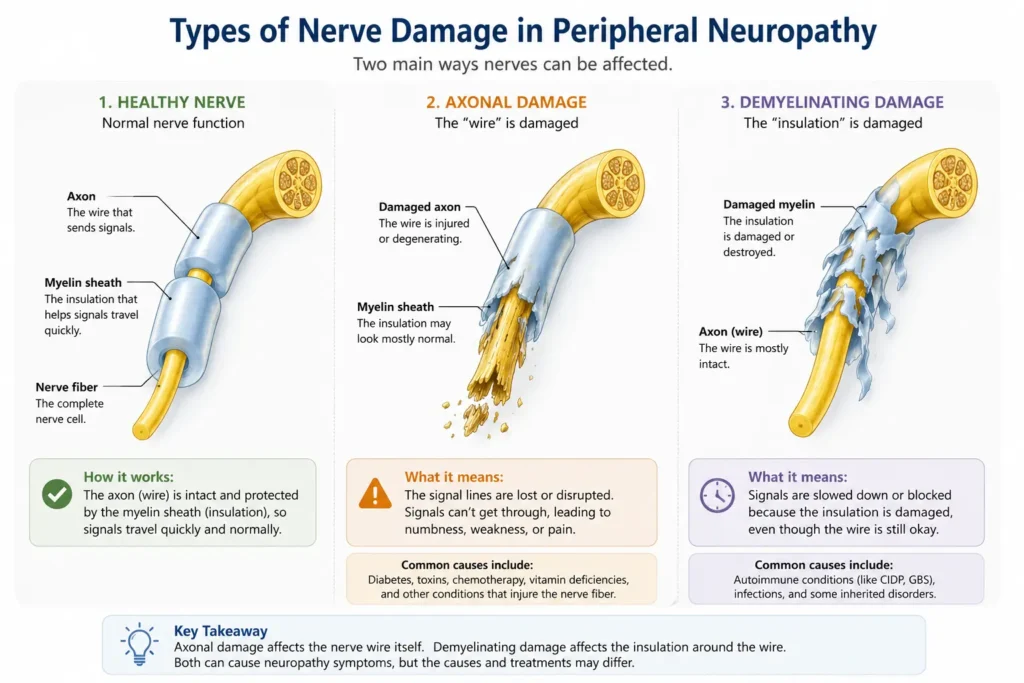
Axon
The long part of a nerve that carries messages between the brain and body. Think of it as the nerve “wire.”
Axonal Neuropathy
A type of neuropathy where the nerve fibres themselves become damaged.
You may see wording like “axonal sensory motor polyneuropathy” on medical reports or diagnosis letters.
Plain English: the nerve wiring itself has been damaged.
B
Balance Problems
Many people with neuropathy feel unsteady or less confident walking.
Sometimes also described as unsteadiness, dizziness, or vertigo.
This often happens because the feet are no longer sending clear messages to the brain about position and movement.
Some people describe it as “walking on cotton wool” or “not quite trusting my feet anymore.”
C
Chronic
In relation to peripheral neuropathy, “chronic” means the nerve damage and resulting symptoms are long-term—typically lasting three months or more
D
Demyelinating Neuropathy
A type of neuropathy where the protective coating around nerves becomes damaged.
Because this protective layer helps nerve messages travel quickly, damage may slow signals between nerves and muscles.
Symptoms may include weakness, numbness, tingling, poor coordination and balance problems.
Plain English: the nerve insulation has been damaged rather than the wire itself.
I
Idiopathic Neuropathy
Neuropathy where no clear cause has been found, even after medical tests.
This can feel deeply frustrating.
It does not mean imaginary, untreatable or hopeless.
It simply means: “At the moment, we do not know the exact cause.”
M
Myelin Sheath
The protective coating around some nerves.
Think of it like insulation around an electrical wire.
If this protective layer becomes damaged, it may be described as demyelinating neuropathy.
N
Nerve Conduction Study
A test used to measure how well electrical signals travel through nerves.
Small electrical pulses are applied to different areas of the body.
It sounds worse than it usually is — although many people would probably describe it as uncomfortable rather than painful.
Neurologist
A doctor specialising in the nervous system, including nerves, the brain and spinal cord.
Neuropathic Pain
Pain caused by damaged nerves.
People often describe it as burning, stabbing, electric shocks, buzzing, crawling sensations or tingling.
Numbness
Reduced or absent feeling.
For many people, numbness first appears in the toes, feet or fingertips.
P
Paraesthesia
A medical word for strange sensations that can be hard to describe, such as tingling, prickling, buzzing, crawling feelings or pins and needles.
Peripheral Neuropathy
A broad term used when peripheral nerves become damaged.
Symptoms vary depending on which nerves are affected.
Polyneuropathy
Neuropathy affecting many nerves.
This is especially common when symptoms affect both feet or both hands.
R
Romberg Test
The Romberg test is a neurological exam most likely carried out in the first instance by a Doctor and often again by the Neurologist or Consultant and is used to assess your sense of balance and proprioception (awareness of body position).
Negative Romberg: Patient remains fairly stable with eyes open and closed, sometimes there may be slight swaying. This would be considered normal.
Positive Romberg: Patient maintains balance with eyes open but sometimes noticeably, within seconds begins to sway (losing balance) when they close their eyes.
S
Sensory Neuropathy
Neuropathy mainly affecting feeling and sensation.
Symptoms may include numbness, tingling, burning pain and unusual sensations.
Small Fibre Neuropathy
A type of neuropathy affecting small nerve fibres.
People often describe burning feet, hypersensitive skin, strange sensations and temperature changes.
One frustrating part is that standard nerve tests may sometimes appear normal.
Stocking-and-Glove Pattern
A common neuropathy pattern where symptoms start in the feet and later may affect the hands.
Think: stockings first, gloves later.
Understanding Diagnosis Wording
Hospital diagnosis wording can look terrifying at first glance.
But most long medical phrases are really just descriptive words joined together.
Let’s take one example:
Idiopathic Sensory Motor Axonal Polyneuropathy
- Idiopathic = cause unknown
- Sensory = affects feeling or sensation
- Motor = affects movement or strength
- Axonal = nerve fibre damage
- Polyneuropathy = many nerves affected
In plain English
Many nerves are affected, involving both sensation and movement, where the nerve fibres themselves are damaged and the exact cause is not currently known.
Suddenly it feels a lot less frightening.
Medical Disclaimer
This article is for educational and informational purposes only and should not be considered medical advice. Always consult your doctor, neurologist, or healthcare professional regarding symptoms, diagnosis, treatment options, or changes to your healthcare plan. Medical knowledge changes over time, and treatment decisions should always be based on your individual circumstances and professional medical guidance.
If you experience new symptoms, worsening symptoms, falls, sudden weakness, or concerns about your health, seek professional medical advice promptly.